
Vestibule scope covers the interior glass on both faces, the entry door and its hardware, the floor including the corners where leaves and receipts drift, the ATM fascia and surround, the trash receptacle, the ceiling vent and light fixture, and the walls where they get marked. Where a vestibule is card-access after hours, we work to the same credentialing as the branch.
Bank cleaning services Anaheim
Financial Institution Cleaning in Anaheim
Banks, credit unions, and lending offices need a cleaning vendor who understands that access is the contract. We clean branches and financial offices across Anaheim and Orange County, work under your after-hours access and camera procedures, and keep the crew small, named, and consistent. Call 657-999-1949.
✓Written scope✓Flexible scheduling✓Anaheim & Orange County
Access is the first conversation, not the last
In most buildings we quote the scope and then work out the keys. In a branch it is the reverse. How a crew gets in, who knows they are coming, what the alarm procedure is, which areas are off limits, and what happens if something goes wrong are the questions that decide whether a vendor can serve you at all.
We work to whatever your institution's procedure already is rather than proposing our own. In practice that means one of three arrangements: crews escorted by a branch employee or your contracted security officer for the whole visit; crews granted their own alarm codes under individually issued credentials, with arrival and departure logged; or a supervised arrangement where a named supervisor holds access and the crew works only while that supervisor is on site.
Escorted service costs more, because it ties up one of your people. Some institutions require it and that is a legitimate policy choice, not something to be talked out of. We will tell you honestly which arrangement is cheaper and which your own security team is likely to approve, and we will not press for broader access than you want to grant.
ATM vestibules and drive-up lanes
ATM areas take public traffic at all hours with nobody watching, and they show it. A dirty vestibule reads as an unmonitored one, which affects more than presentation.
Drive-up lanes and exterior ATM surrounds are exterior scope: the pavement apron, the machine fascia and screen surround, the trash receptacle, cobwebs in the canopy, and the pneumatic tube carriers and their housings where you still run them. Pressure washing of the apron runs on a periodic cycle, because oil drips and drink spills accumulate in a lane that never gets rained on under a canopy.
The lobby and the teller line
A branch lobby is doing a job that is entirely presentational. It exists to make someone comfortable handing over money, so the standard is higher than the soil level warrants.
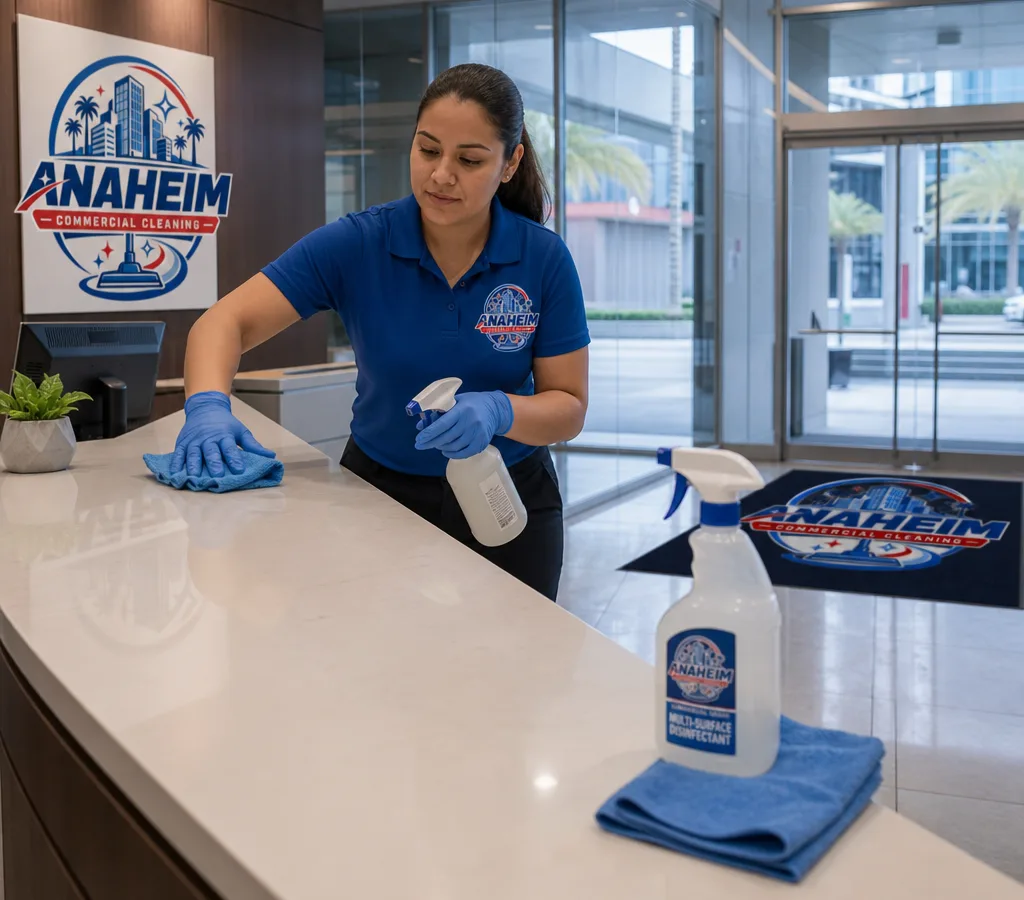
Lobby scope: entry glass inside and out with frames and push plates, because fingerprints on a branch door are read as inattention; hard floor or carpet, with the entry lane getting the attention; the writing desk or counter and its supplies area; brochure racks and displays; seating, including the arms and the backs; tables; and the vent grilles and light fixtures that show dust under bright lobby lighting.
Teller line and counter work is more constrained than it looks. Counter tops, the front face of the counter, the glass or acrylic screens where present, and the customer-side surfaces are ours. Behind the counter, the drawer units, keyboards, monitors, cash equipment, and anything in a teller's work area are touched only to the extent your policy allows, and in most branches we clean floors and empty trash there and leave surfaces alone. Where you want teller-side surfaces wiped, we need it in writing in the scope so it is a documented instruction and not a judgment call made at 9pm.
Trash from a teller station or a back office is handled without sorting or inspecting. Where documents go into a locked shred container, we do not open it, empty it, or move it.
Check Availability
Vaults, secure areas, and where we stop
Every branch has areas a cleaning crew should not enter, and the line should be drawn by you, marked on a floor plan, and included in the scope document rather than explained verbally on the first night.
Typically off limits entirely: the vault and its interior, safe deposit box areas, cash handling and recycler rooms, night depository interiors, alarm and security equipment rooms, and IT or server rooms. Crews are instructed not to enter those spaces even if a door is unlocked, and to report an unsecured door rather than close it themselves.
Where a secure area does need cleaning, it happens escorted, on a scheduled visit, with your staff present for the duration. That is slower and more expensive than the rest of the work, and it is the only responsible way to do it.
Discretion in a building full of paper
Branches and lending offices contain customer information in physical form: applications on a desk, statements at a workstation, files on a credenza, a whiteboard with account notes on it.
Our instruction to crews is straightforward. Do not read, move, photograph, or discuss anything on a desk or screen. Clean around paperwork, not through it. Do not tidy documents into a pile. If a document is on the floor, leave it and report it rather than handling it. No personal phones out on the branch floor.
Crews on financial accounts go through our hiring screening including a background check before assignment, and we keep the assigned team consistent and small so the same named people are in your branch each visit. Supervisors are identified to you by name. If your institution requires its own vendor screening, additional documentation, or a confidentiality agreement signed by individual crew members, send it during the walk-through and we will confirm in writing what we can meet before you commit to anything.
What we will not tell you is that a cleaning contract makes your branch compliant with a regulation or a vendor management standard. It does not. It gives you a documented vendor procedure, a consistent crew, and a visit log, which is what your own program can use.
Cleaning a branch that closes at five
Branch hours make scheduling simpler than retail or restaurants and more constrained than offices.
- ✓Most branches are cleaned after close, often between 6pm and 10pm, with the crew in and out inside a defined window that your alarm schedule and monitoring expect. Deviating from that window matters: an arrival outside the expected time generates an alarm response and a phone call to your branch manager, so we treat the agreed window as fixed rather than approximate.
- ✓Branches with Saturday hours need the weekend visit planned separately, since the building is typically empty Sunday and a Saturday-evening or Sunday clean can give a longer window. Corporate and back-office floors in a multi-tenant building follow the building's own access rules and often have a different crew and a different schedule from the branch below.
- ✓Day porter service suits high-traffic downtown and flagship branches: lobby glass, restrooms, and the vestibule held through open hours, with the full clean still happening after close.
What the price depends on
Access arrangement. Escorted service is the single biggest variable, because it converts an efficient visit into one paced by your staff's availability.
Branch count and consistency. A route of several branches on the same schedule prices better per site than a single location, and it is common in Orange County where institutions run six or eight nearby branches.
Lobby size and finish. A large stone or polished floor with heavy entry traffic carries a periodic maintenance program a carpeted lobby does not.
Vestibule and drive-up scope. An ATM vestibule or a two-lane drive-up adds exterior work and its own periodic pressure washing.
Frequency. Five nights a week is standard for a branch lobby. Some smaller offices run three, which works if you accept that the entry glass will not always look like it was done that morning.
Restroom count and public access. Public restrooms drive frequency more than anything else on the list.
Periodic items. Floor restoration, carpet extraction, high dusting, exterior glass, and pressure washing are quoted separately on their own intervals.
Questions branch and facilities managers ask
Will your crew have alarm codes?
Only if your policy allows it. We work escorted, supervised, or individually credentialed, whichever your security team approves, and we will not push for more access than you offer.
Do you clean behind the teller line?
Floors and trash, yes. Work surfaces, equipment, and anything in a teller station are only touched if your scope document says so explicitly.
Are crews background checked?
Yes, as part of our hiring process for staff placed on financial accounts, and we keep the crew consistent. If you have vendor screening requirements of your own, we will review them and confirm in writing what we can meet.
Can you clean multiple branches on one contract?
Yes, and it is usually the better arrangement. One scope, one schedule, one supervisor, and consistent standards across the route.
What happens if the alarm is triggered?
We follow your procedure, which normally means our supervisor contacts your named after-hours contact and remains on site for the response. We would rather agree that sequence during the walk-through than improvise it.
Can you handle our shred bins?
No. We do not open, empty, or move locked shred containers. Those stay with your document destruction vendor.
Do you clean the vault?
Only escorted, on a scheduled visit, with your staff present. Never on a routine unescorted visit.
Tell us how many locations, your access policy, and your closing hours.
Check AvailabilityRequest a branch quote
We will walk one branch, mark the off-limits areas on a plan with you, and quote the route in writing. Anaheim Commercial Cleaning, 4091 E. La Palma Ave, Anaheim, CA. Call 657-999-1949.
Request a quote
Tell us about your facility
Send the building type, approximate size and how often you want service. We will reply with a walkthrough time.